Parenting and work: why it’s not just a ‘mother’s problem’
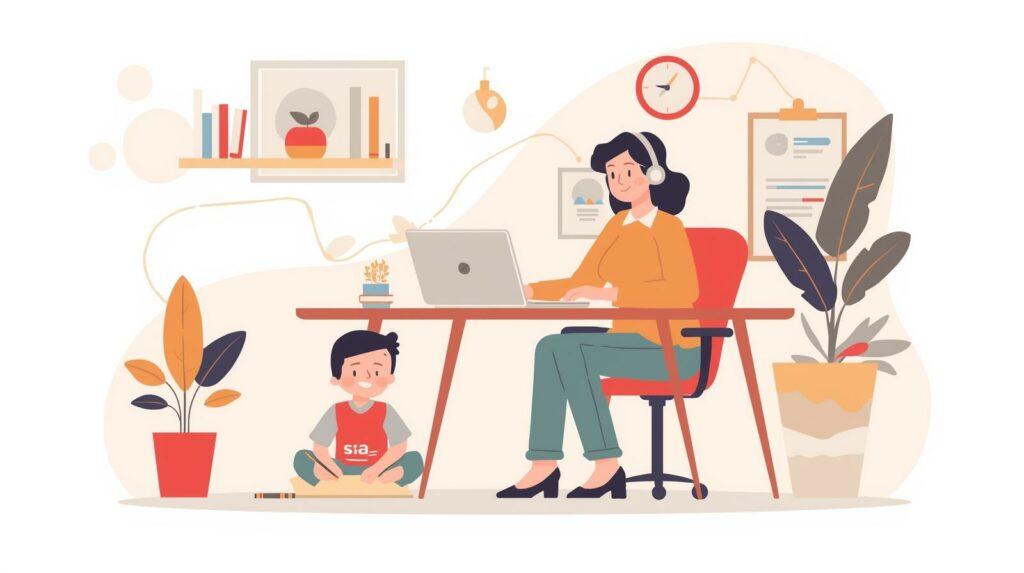
Analyis of the sociology of parenthood in DE&I, including the child penalty and mental load. Learn why normalizing fatherhood is essential to closing the workplace gender gap.
#GenderGap #DEI #Parenthood #WorkLifeBalance #MentalLoad #WorkingParents #Inclusion
If there is one question that haunts women aged 25–35 during job interviews, even though it is illegal, it is that of family planning. It is an overwhelming “unspoken” issue. For men, on the other hand, parenthood is often seen as a sign of stability and maturity that does not affect productivity.
Therefore, if we are to discuss the gender gap and parenthood from a diversity, equity and inclusion (DE&I) perspective, we must start with social perception. It’s not just about numbers, percentages or wage gaps (which do exist and are significant), but also about how our society has constructed the idea of the ‘ideal worker’ and how this concept is crumbling under the weight of modern reality.
The concept of the ‘disembodied worker’ has dominated the world of work for decades. This model is based on a white, able-bodied man who can devote himself body and soul to the company because someone else is taking care of everything else at home (cleaning, cooking, looking after children and the elderly). In sociology, this concept is akin to that of the disembodied worker: an entity that exists solely to produce, free from the constraints of social reproduction.
The problem arises when women, or rather mothers, enter this scenario. Motherhood makes the body ‘visible’. Suddenly, pregnancy, breastfeeding and the physical need to be present become issues. In a system that rewards absence of constraint, motherhood becomes a ‘manufacturing defect’. This is where the ‘child penalty’ comes in: the economic and professional cost that women pay for having children. This cost is almost non-existent, or even reversed, for fathers, the so-called ‘fatherhood bonus’, whereby fathers are sometimes paid more because they are perceived as ‘reliable breadwinners’.
From a DE&I perspective, addressing this issue is not about ‘helping poor mothers’. It means dismantling the idea that the ideal worker has no life outside of work. It means recognising that caregiving is not a hobby, but the very foundation that enables the economy to function.
Mental load and double presence
If we look inside homes, we see that the gender gap does not end when we finish work. Years ago, the Italian sociologist Laura Balbo coined the term ‘double presence’, referring to the need for women to perform well both at work and at home. Today, we could talk about ‘triple presence’ if we also consider the emotional and organisational management of the family, what is referred to as ‘mental load’.
It’s not just a question of who changes nappies or takes the children to school. It’s also about who remembers to buy nappies, that there’s a school trip tomorrow and money is needed, and that the paediatrician needs to be booked. Statistically, this invisible manager of the family is almost always the woman.
This invisible cognitive load can have a devastating impact on careers. If your brain is constantly occupied with twenty browser tabs related to family management, you will have less energy for innovation, networking or last-minute overtime at work. Companies that ignore this issue and limit themselves to ‘Happy Mother’s Day’ wishes are engaging in pinkwashing, not inclusion. True equity requires an understanding that time and energy are finite resources, and that the unequal distribution of care work at home inevitably leads to inequalities in the workplace.
Fathers are the elephant in the DE&I room
We will never solve the problem of mothers if we don’t address the problem of fathers. In many corporate cultures, a man who asks for parental leave or leaves early to take his child to sports practice is viewed with suspicion. There is a strong social stigma attached to men who want to take care of their families.
The sociology of masculinity teaches us that male identity has historically been based on financial provision (breadwinner). If a man moves into the role of caregiver, he faces social sanctions. However, if fathers do not take leave and normalise absence from work for family reasons, mothers will always be seen as the only unreliable employees.
A serious DE&I strategy must focus heavily on male parenting. Offering paternity leave is not enough; it must be made culturally acceptable, if not mandatory, and strongly encouraged by senior management. When a male CEO takes three months off to be with his newborn baby, this sends a much stronger message than any seminar on female empowerment.
Flexibility or ghettoisation?
In recent years, the magic word has been ‘smart working’ or ‘agile working’. It seemed like a solution to all the problems of the gender gap. Yet the data tells us that we need to be careful. If flexibility becomes a concession made only to mothers to ‘manage their children’, we risk creating a ghetto. While women work from home, managing the washing machine and the phone at the same time, men return to the office, network at the coffee machine and get promoted because they are ‘visible’.
The sociology of work warns us of the risk of re-traditionalising roles through technology. If smart working is not accompanied by a work culture based on objectives rather than physical presence, it will simply be another way for women to juggle two jobs while remaining invisible in terms of their careers.
For DE&I to work, flexibility must be universal and ‘gender-neutral’. It should be normal for everyone, from interns to directors, to work remotely or have flexible hours. Only when flexibility is no longer exclusively associated with motherhood will it cease to be a career obstacle.
Rewriting the social contract in the workplace
Addressing the gender gap in parenting requires a paradigm shift. It’s not about “accommodating” women in a male-dominated system; it’s about redesigning the system to embrace the whole person.
Companies must begin to recognise that parenthood is not a period of ‘break’ from professional development, but rather a life phase that fosters invaluable soft skills. Time management, negotiation (try convincing a two-year-old to eat their vegetables), crisis management and empathy are all skills that parents hone daily which are also valuable in the workplace.
Bridging the gender gap in parenting is a matter of social justice and economic intelligence. Companies that retain female talent after maternity leave and enable men to experience fatherhood fully are happier, more productive and more innovative.
We don’t need flowers on 8 March. What we need are nurseries, equal leave and equal pay. Above all, we need to stop watching the clock when a colleague (whether male or female) leaves to pick up their children from school. A real sociological revolution will begin when caring for life is no longer seen as an obstacle to work, but as an integral part of a healthy working society.